

 As a follow up to my recent blogs about The Shape of the UK Recruitment Market and the review of Growth Street I thought we’d share 4 key things to ask your lender before taking cash flow finance. Massive thank you Greg Carter, CFA and his team at Growth Street for their help with this article.
Am I the right borrower for you?
Lenders all have different objectives and risk appetites. Your likelihood of getting finance at a good rate depends on approaching the right lender for your business.
A good idea is to think about how a lender will look at your recruitment service.
You have to consider the character of your business – credit risk and the underlying character is key. Ability in terms of repayment and how the facility is used is top of mind for any lender. How is the profitability and margin looking? The purpose of the finance is important – particularly to overdraft providers, as they want it to reset to zero. Depending on the amount you need you will find that overdrafts will be easy for amounts up to £30k, harder for amounts up to £80-100k and challenging for amounts over £100k. All lenders care about repayment and while invoice financers has this covered since they control the invoice, it is important for overdraft providers to see historical cash flow generation. In case something goes wrong thinking about insurance and security is important.
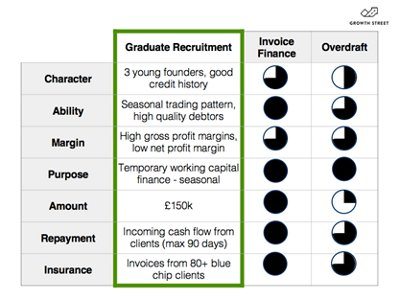
If it looks like invoice finance might be a good fit it is still important to take a deeper look….
How will my usage affect my cost?
A key element to remember with invoice finance is that you are typically charged service fees regardless of whether you use the cash available to you or not. This can dramatically alter the cost.
Take this example. With moderate cash flow finance taking £150,000 out of current assets for reinvestment elsewhere in the business, the difference between invoice finance and overdraft is stark.
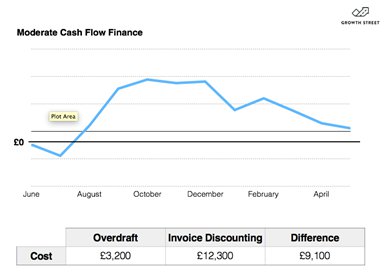
With invoice finance, don’t be fooled by the attractive sounding interest rates. Actually, around 4/5 of the cost are in the fees and these are largely fixed regardless of whether you use the finance or not because they are based on turnover. So from a cost perspective, it is more akin to an interest only loan, than revolving credit.
What are the fees…really?
You’ve all seen the headline fees. However, there are several other elements to consider.
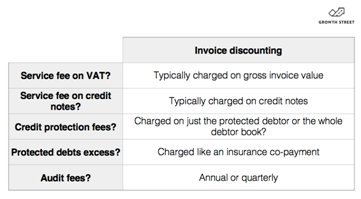
The place to really dive into the costs is with invoice discounting and in particular the ways in which the service fee is charged.
For example, the service fee is typically charged on the gross invoice value, which means inclusive of VAT. However, you will often only be able to borrow a certain proportion of the net invoice value! Be sure to consider how those fees on VAT will impact your expectations of cost.
Also inquire how any credit protection fees are being charged. We’ve seen examples were this was required due to the presence of one particular debtor, but the ‘T & C’ revealed that the protection fee would be charged on the whole debtor book. This increased the service fee costs by 67%.
How much time will you spend?
Remember fees aren’t the only cost. Your time has a cost and is often more expensive. For your recruitment business, an overdraft would be relatively light touch once established, and the accounting straightforward. However, the management of an invoice finance facility can be much more time-consuming. It will require monthly or weekly downloads of your debtor book, and will conduct spot checks to verify invoices even in the case of a confidential facility. They will also have quarterly or annual audits of your systems to ensure. From the various FDs we’ve spoken to, the management time of an invoice finance facility can be considerable, both providing the information they require and then reconciling it to your own accounts. We have heard examples from many businesses that it takes a half time bookkeeper to manage a small invoice finance facility. That’s potentially another £2,000 per month cost on top of the fees which you should consider.
So, in summary
1. Find out what the lender wants
2. Know yourself (and your usage)
3. Take time to understand the fees
4. Understand that your time is valuable too
Growth Street aims to make it easier for growing small businesses to take the next step by providing fast access to fairly priced flexible credit. If you missed my review of their offering it’s here.




Hi Louise, I am sure this was not your intention but having spent the last 30 plus years working in both the business banking and invoice finance arena in the UK, I don’t feel this article is wholly accurate or helpful to recruitment firms but it does highlight the need for them to seek expert advise from independent advisers who are able to help them find both the right lender and the right facility. Invoice Finance has and I am sure will continue to be the friend of UK recruitment businesses and can provide flexible and cost efficient finance when traditional lending methods are unable to provide the required level and flexibility of funding. I have no knowledge of Growth Street but clearly they have influenced what could have been a really useful article into something which feels more like a paid for piece of PR for their own business which is a shame for anyone reading it but hopefully it will be taken in this context rather than one with factual accuracy which is flawed in many places in my opinion
Julie
Julie
I don’t know if this would be of interest to you – but I’d be happy to take a guest post from you on this subject. Always happy to give as much useful advice as possible.