

 The ‘run for talent’ is at its all time high. According to the members of The Society for Human Resource Management, the last decade saw a trend towards hiring quickly and at low cost rather focusing on superior candidate experience. While this sounds great short term, the hard truth is the fact that it’s harming your bottom line in the long term. Alex Jost, Product Marketing Manager at our partners Starred shares his own thoughts on candidate experience.
My aim in this article is to provide ammunition to anyone in staffing or talent acquisition having a hard time convincing their Finance Department to spend money on creating a good Candidate Experience.
The discussion shouldn’t be about spending money on Candidate Experience, but about how much it will save: bottom line is that your investments in it are ROI positive. It’s time to think in terms of the return, because there’s everything to gain.
Let’s dive into three main areas where good Candidate Experience can impact your bottom line.
#1. Good Candidate Experiences means better Candidate Retention and Conversions
First let’s look solely at the recruitment process itself.
Every company is eager to hire ‘A-players’. These A-players set the bar high for themselves, but also for the companies that want to hire them. They will extrapolate the impression they get from the Candidate Experience to how the company will be past onboarding.
The mechanics of poor candidate retention come into effect here. They will wow your hiring team for sure, and therefore they need to be ‘wowed’ in return. Not providing great experience? They’ll withdraw their application and you will be stuck with ‘B-material’. The problem with these people is that they will most likely hire C-players since they’re afraid smarter people will take their jobs. Before you know it, you’ll have a company full of mediocre people and your chances for success will decline rapidly.
Let’s recap the ways to increase conversions with Candidate Experience front of mind:
- Fact: prospective employees research your company through your career site. Well, the smart ones will. Keep the application as short as possible, while capturing the information you need. Someone who can apply to your job without unnecessary clicks, pages, or having to answer long, daunting questions is much more likely to fall into your funnel. Extra requirements such as username and password creation complicate the process, and is best served at the end or never at all.
- If you reduce time-to-apply from 15min+ to 1-5 mins you are likely to save 28% on media costs. You will also improve time-to-hire because you’re not losing viable candidates. The best talent needs to arrive in your process unscathed by terrible online applications.
- Try not to keep people in your process for more than 30 days. If your competitor is moving faster than you, chances are big they will choose them over you. So much of good candidate experience is about keeping tight communication and informing your candidates.
#2. Build a superior Employer Brand & get more referrals
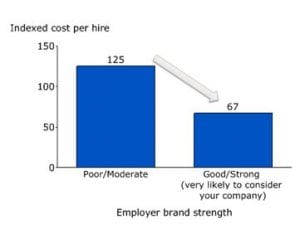
A recent LinkedIn Study surveyed 2,250 corporate recruiters in the US to learn more about time-to-hire, cost-per-hire metrics and most importantly the impact of a strong employer brand. They found that companies that have strong employer brands enjoy significant cost savings with lower cost-per-hire and employee turnover rates.
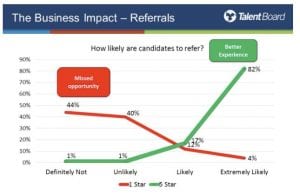
 TalentBoard found that for most candidates that have an overall 5-star experience, didn’t get the job at the end of the day. Even after this rejection, 64% of the time, candidates are willing to increase the business relationship with that company that they applied to. In real terms, they will buy more and will buy again. And here’s the big one – they will refer you more candidates.
 Bonus benefit: Companies with stronger employer brands have 28% lower turnover rates than companies with weaker employer brands..
The return on experience angle of candidate experience should be resonating by now.
#3. Candidate Experience means revenue growth
The easiest way to convince people internally about the importance of a good Candidate Experience is when your candidate is also your customer. People don’t drop off the face of the earth the second they leave your recruitment funnel. They will come across your brand again, with their candidate experience front-of-mind.
What’s the business impact? A global survey by Software Advice revealed that 42% of candidates who have a bad experience are somewhat to highly likely to cease buying goods from that company. 34% are somewhat to highly likely to tell their friends not to buy from that company. Put in plainer language: this means almost half of your candidates who have a bad experience won’t buy from you again. A third of them will tell their friends never to buy from you again.
Take the often-discussed Virgin Media case which did the rounds on LinkedIn about how bad candidate experience cost them over 5 million dollars annually. The calculation was fairly straightforward. There were 123,000 rejected candidates each year, and 6% canceled their monthly Virgin Media subscription because of bad candidate experience, so they ended up with about 7,500 cancellations. Multiply that by the $60 subscription fee and by 12 months. Doesn’t take a lot to see that lost business because of bad candidate experience is costly. Unhappy candidates mean unhappy customers. Quite simple.
Virgin Media managed to turn the ship around and the result is impressive: it’s 10 times cheaper to gain business from the recruiting process (it only costs $50 versus $500 for traditional marketing).
Is Candidate Experience ROI positive?
Let’s be honest, you can find an ‘ROI positive’ article for almost everything on the internet. The problem with an article like this one is the fact that there are a number of stats out there, but no actual data. ‘If we can’t measure it, we can’t improve it’ will be a common response from your Finance Department when confronted with ‘yet another ROI case’.
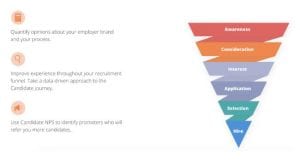
The answer to this is easy: Start measuring your Candidate Experience in an automated way. Establish a baseline Candidate Net Promoter Score, and start optimizing from there. Combine these results with several of your own recruitment metrics:
- The time candidates are in the process
- Acceptance rate
- Number of withdrawals
- Money spent per applicant
Keep a close eye on these metrics and how they are evolving (and hopefully, improving over time once you start measuring and optimising the Candidate Experience).
 Return on Experience: Proof’s in the pudding
 Return on Experience: Proof’s in the pudding
The arguments I’ve given here for ‘Return on Experience’ have hopefully turned that ship around.
First – You can prove that superior Candidate Experience increases conversions. Sales funnels are constantly under scrutiny in efforts to optimize their effectiveness. It’s time to think the same way about your recruitment funnel. Second – building an employer brand in this age is vitally important, and it earns you more referrals – one of your primary growth levers. Thirdly – Candidate Experience forces you to consider the consumer-side impact of good and bad experience. Good candidate experience drives increases in revenue.
Basing ROI calculations on lost business will depend largely on the type of business you run. It requires complex analysis. When it comes to CX lost business can range from nothing to millions annually. Here I hope to have given you an idea of what this all boils down to: bad Candidate Experience harms your bottom line, and positive CX drives expansion of your core business. Combine these investments in Candidate Experience with a far smaller investment in a solution to measure the impact of CX, and you’ll be surprised what a positive ROI impact this will have!
Starred builds pro feedback software for the recruitment industry. Collect, Analyse and Act on Candidate Experience feedback. Plugged right into your CRM or ATS, automated to your touchpoints. Learn how Starred helps you take control of your Candidate Experience.