

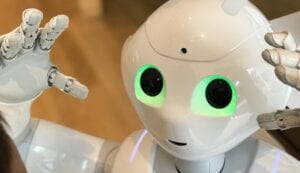
 A side effect of the current pandemic is that businesses, and society as a whole, has been thrust into a no holds barred sprint to the future, with little time to look back. The unique problems caused by coronavirus have forced our collective hand in many areas. We’ve seen changes come into effect that would have been unimaginable last year. Here our partners, JobLookUp, share their thoughts on the rise of Robotics and the Recruitment Impacts!
Remote working is perhaps the most obvious example, but there are others. The idea of a universal basic income is one that was only being tentatively trialled by the most forward-thinking of countries before the pandemic. Now, it’s something that is seriously being considered by a number of governments ranging from South Korea to the UK, as a potential way to offset the inevitable wave of job losses and economic destruction caused by COVID.
Then we have robotics. This is another area that has benefitted from an increased burst of interest and investment in recent months. It’s nothing new, of course. We’re all used to hearing about how AI, automation, and robots are increasingly well poised to start ‘taking over’ a variety of jobs by now. The interesting thing about robotics though, is that while they have been active in some industries for a long time already, there has always been a fairly clear separation between man and machine in the workplace. Robots are often relegated to manufacturing floors or assembly areas where humans rarely tread.
That is changing. Our workspaces are already becoming places where humans and robots work side by side. This year alone some major brands have shown a new interest in robotics, driven by the changing and uncertain climate created by coronavirus. Whether it’s Tesco trialling drone deliveries in Ireland, or Ocado investing in a robotics company, the mass replacement and/or enhancement of human work by machines is now closer than ever. It has, in fact, already begun.
Often, previous discussions around the impacts of robotics on employment have centred around those roles which are considered ‘low skilled’. If recent events are anything to go by, however, it isn’t only ‘low skilled’ jobs that are at risk from machines.
If you follow technology in general, you’ll probably be aware of Boston Dynamics and their unnervingly efficient robots. What you might not be aware of is how the lovable robot dog ‘Spot’ has made the jump from novel curiosity to workplace reality. One ‘Spot’ robot even has an employee number at the Norwegian oil company Aker BP. The job it performs is not ‘low skilled’ either, and it’s not even the yellow quadruped’s first gig. ‘Spot’ has been used by police forces and construction firms since being available to buy for commercial purposes, and as of June this year, it’s become available to the general public too.
This raises an interesting issue, in that the ‘threat’ to jobs from robotics might not purely be limited to those areas we previously thought. If that’s the case, how could the widespread adoption of robots affect recruitment?
Firstly, let’s consider demand. Last year, robotics sales came to $13 billion, and are expected to more than double by 2022. That’s only a year away, essentially. While not every robot is going to replace one job, such a flood of automated labour is certainly going to cause a stir. It’s important to note that some sectors are innately more geared to benefit from robots than others currently, however.
Healthcare is one such case. Robotics uptake in this sector expected to be huge, and is already significant. The Da Vinci Surgical system, for example, has already performed over 20,000 successful surgeries, and usage of this system alone expected to increase exponentially. Then there’s the porter style robots and other semi-autonomous healthcare systems to consider.
Service robots, also known rather affectionately as ‘cobots’ (collaborative robots) are likely to see a huge increase in use too, especially in the service, retail, and hospitality sectors. Cobots are defined by the International Foundation for Robotics as those that ‘perform useful tasks for humans or equipment excluding industrial automation applications’. By 2035, an Oxford University study suggested that almost 90% of restaurant jobs will be automated, as well as three-quarters of retail jobs.
When you add in the challenges faced by these sectors in the current climate, along with the fact that we’re likely to be in the grip of social distancing and lockdowns on and off for at least another six months to a year, then we may see the uptake of robotics in these industries accelerate even faster.
Does this mean that recruiters will be spending the next 10 years of their careers liaising in binary with WaiterBot 78275562? Of course not. What it does mean though, is that the human roles in many workplaces will drastically change. New jobs will be created, and the while some will certainly be lost, most predictions expect more of a shift in role types and priorities.
Shifting properties means a shifting focus on skills, and it goes without saying that spotting candidates with the relevant skills will be as important as ever for recruiters. Knowing what those skills are going to be, of course, is crucial too. You might expect an increased focus on technical skills and engineering, but there are many credible suggestions the opposite will be true.
Socio-emotional skills, such as empathy, communication, and emotional intelligence are expected to be particularly valuable. We’re also likely to see an increase in management and senior roles that involve more critical thinking, problem-solving, and a general focus on the human aspects of a business, like HR.
While many recruitment companies might already have their long-term eyes on these changing priorities, those that are ready to hit the ground running, and able to seek out and provide the best candidates for a robotics laced employment landscape are certain to fare well.
As with most things during 2020, these are all considerations that are now having to made sooner rather than later. In the end, perhaps that’s not such a bad thing. Whether we’re recruiters, employers, or jobseekers, we should be ready to welcome our new robot overlords, I mean cobot co-workers, with open arms.
Author biography:
Simon Marshall, Head of Content and Communications at JobLookup.
Simon is a technology enthusiast with an interest in how the application of science, philosophy, ethics, and psychology can benefit us in both the workplace and wider society.