

 Kayte Ferris of Beringer Tame was our Roving Reporter for LinkedIn’s Social RecruitIn recent event. Here is her roundup.
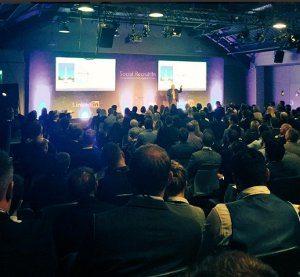
On Wednesday 7th October, recruitment entrepreneurs, managers and marketers descended on Islington for LinkedIn’s Social RecruitIn. The event was themed the ‘Art and Science of Recruitment’, a theme that extended into the décor, but not so much the content. The coffee/lunch/phone charging area was divided in two by a giant left brain and right brain that trailed up the stairs in the centre of the room. Each side of the room had left/right brain appropriate games (creative or reasoning), although the food was the same no matter which queue you took.
Despite the visual investment in the theme, the speakers themselves danced to their own tune. The event’s organisers had big name keynote speakers: James Caan, Lou Adler and Susie Wolff.
Caan’s keynote was scant on detail but high on big ideas. He talked about how average fees have remained constant for the last twenty years despite recruiters having more tools at their disposal. Quite a shocking point when you consider that recruiting in 1995 was all phone books, paper CVs and fax machines, whereas in 2015 a recruiter can find someone within two clicks of a mouse (or taps of a smartphone).
Caan’s argument was that the recruitment agency should be far more efficient today now that they’re not physically sifting CVs and have targeted digital tools. He places the blame at the door of recruitment managers; he believes that training focuses on traditional recruiting techniques and that recruiters have yet to marry those with the true potential of digital media. As such, he announced he is launching a free training app in 2016.
US recruitment entrepreneur Lou Adler was perhaps the Keynote of the day, going into some great detail about his performance-based hiring model. His was at base a client and candidate control piece, yet the presentation was much more inspirational.
Adler suggests arrangements with clients where you promise to send them the top third of all candidates you find in return for the client interviewing 100% of them. Not unreasonable, but how many of us actually do that? Similarly, he noted that candidates have plenty of people in their lives advising them (partner, friends, family); your job as a recruiter is to give them the arguments for those discussions.
His performance-based hiring model was truly inspiring. He argued that in a scarcity market, which most of the room operated in, it is not enough to offer someone a lateral move. You have to offer someone a career move, a 30% non-monetary increase across job stretch, job growth and job satisfaction.
However, someone moving up in their career isn’t going to have the skills and experience listed on the client’s job spec. Performance-based hiring solves this problem. Rather than have client’s dictate what a candidate must have, recruiters should push back and ask “what will a candidate need to do to be successful?” More often than not the answer is a selection of soft skills like leadership, being inspirational and commerciality. The recruiter therefore needs to learn to recognise performance indicators that show a candidate can fulfil the success criteria, for example, being given advanced projects or a history of quick promotion. Rather than matching skills to jobs specs, it becomes a case of matching potential to success.
As with most events like this you expect there to be a balancing act between useful, engaging content and sales pitches. Between the keynotes were panel discussions around themes like employer branding, the social CEO and data leverage. We had to choose between two for each of these sessions.
The panels were made of recruitment company owners and CMOs, chaired by a LinkedIn bigwig. The memo here was very clear: talk about how useful your LinkedIn products are and how highly you recommend them. And with the exception of the charismatic Peter Cosgrove of CPL, they all obliged. Which was a shame, because some of what was said was legitimate, yet was tainted by the fact that they were obviously all toeing the LinkedIn line.
Key take aways from the session involved emphasising to sales-focused consultants that sharing on social media helps with SEO, and therefore the visibility of their ads, and that having a CEO active on social media is valuable for employer branding and generating trust in the business. As Cosgrove aptly put it: to be the expert, you actually have to tell people how you do it.
The conference closed with the inspirational Susie Wolff talking about her experiences in the male dominated world of Formula1; pertinent, surely, for the women in the audience. Susie highlighted one element of the event which left a bit of a sour taste. The organisers had shipped in what I assumed to be actresses and models for no other reason than to stand around in LinkedIn branded clothing looking beautiful. They were everywhere, and not one of them said anything or directed anyone that I saw. Contrasted with Susie Wolff and the other successful women on the stage and in the audience, this seemed incredibly outdated and crass. To me, it demonstrated that the event was directed at men, despite the fact that at least a third to half of the attendees were women. It was unavoidable, and left me questioning why is this still going on in business in 2015.
 All in all, I was glad I went. From the Keynotes I took some valuable insights which we have already started to implement at Beringer Tame. It is a shame that a lot of the content was marred by an obvious sales focus. A small amount of this is to be expected, but one would hope that the £199 price tag would pare it down a little.