

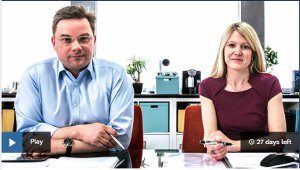
Julia Dowling, MD of Snapdragon, which featured in Channel 4’s The Job Interview earlier this week, shares the lessons she learnt from the process that may be relevant to professional recruiters. You can see Snapdragon on The Job Interview here.
Q: Is “The Job Interview” scripted?
No. The employers are real, the candidates responded to a real job advert, we sifted anonymous CVs, conducted real interviews in our own style and offered a real job. Obviously, conducting an interview on TV is not normal. However the series producers were very keen to portray what happened in the interview room as faithfully as possible, accepting that a whole day of interviews was cut into a 30 minute programme.
Q: How much interview experience have you had?
Prior to founding Snapdragon, both Doug and I had held senior executive roles in large corporates like BT, Deloitte and Barclays. We have conducted countless interviews as hiring managers, although neither of us is an HR professional.
Q: How did interviewing on TV change your approach and what lessons have you learned from this?
As an employer / recruiter, conducting interviews on TV, forces one to think more carefully about how to conduct the interviews and how to engage with interviewees. We knew we would be very publicly judged by the Twitterati.
So while preparation would be good practice for any interview, we spent far longer doing preparation than we would have normally done. In retrospect, we found this so beneficial that we have resolved to follow the same preparation again. We wrote a formal job description and defined the profile of the perfect candidate.. We sifted CVs against this profile and crafted our interview questions to judge people against it. Generic questions often used by lazy or ill-prepared interviewers like ‘tell me about yourself’ or points scoring by pointing our errors on CVs would not help us find the right person. If there are spelling mistakes on a CV, we can draw a conclusion from that without drawing attention to it at interview.
Q: So how did you decide what to cover at interview?
We only had an hour with each candidate, so the interview questions were structured to reveal the person behind the CV as well as probe skills and competencies. We wanted to judge their ability to think on their feet in a pressured situation, to be creative as well as the degree to which they possessed a sense of service and style which are fundamental in our industry. We also wanted people who would not be phased by the large budgets or lavish events we are asked to create by our clients. We then rehearsed in a series of mock interviews on video with a couple of people in the company.
What this meant was that on interview day, we could focus on the people we were meeting. We had spent considerable time on each CV and knew the candidates backgrounds well. An interview is a two way endeavour; the candidate is sizing up the potential manager and the role, just as the recruiter is judging the candidate. Our aim was to engage them in a dialogue which would be useful and productive for us both. A conversation with purpose, rather than disjointed questions from us and sales pitch from them.
Q: An interview process normally involves many stages. How could recruiters apply these lessons in their work?
Two things spring to mind.
Firstly, as an interviewer you want to hire the very best talent. The best talent has options. Every interview is a chance to sell a company and convince the best people that this is where they want to bring their skills to bear. In my experience, early stage interviews can be a formulaic and superficial exploration of generic competencies. Little effort is made to convince the candidate that they should join the company. In my view, this is an opportunity lost.
Often, hiring managers do only minimal preparation for an interview, relying on their ability to think on their feet to get through an interview. Smart candidates can spot this. Recruiters and HR professionals should force hiring managers to think about the candidates they are meeting by preparing for the interviews with them.
Q: Finally, did you enjoy the process and would you do it again?
It took a little time to come to terms with the many TV cameras in the room, but we both enjoyed it. Professionally, I’ve learned from the experience and I would do it again.




[…] NEWSThe Job Interview – great TV, poor candidate prepThe Job Interview – Thoughts from SnapdragonDrive for Growth – Camino e-bookEarly Bird Tickets to our Recruitment Events#755; The 10 best […]