
Click IQ have produced this article for us talking about automating talent attraction in a rapidly changing media landscape
As with any disruptive technology, there is a lot of hypeand fear around how machines will impact our lives and take all of our jobs with AI and automation.
Within our world of Talent Attraction, this is no different – automation is rapidly taking its place in recruitment. Automation is now becoming fundamental to enable recruiters to do the job they do best… hiring exceptional talent.
How will automation have an impact?
There are 3 key stages to a simplified recruitment process, which will be followed and practiced by most Talent teams:
- Attract the best applications (through advertising and sourcing)
- Filter applications (through shortlisting, testing, and interviewing)
- Offer management.
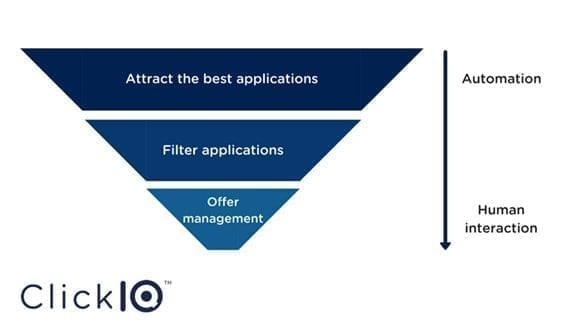
Automation is required to achieve the best results at the top of the funnel. Whereas at the bottom of the funnel, human interaction is critical to achieving the best results as it is much more valuable when it comes to the offer management stage of the recruitment process.
Reasons for this are a combination of the end of the days of post and pray job boards with an increasingly complex media landscape (requiring more active management); and the use of technology that learns.
What has caused the complex, rapidly changing media landscape?
Recruitment sites such as Indeed, LinkedIn, ZipRecruiter, Glassdoor, Adzuna, Neuvoo, JobRapido, Google and Facebook, have all shifted the recruitment advertising landscape to a PPC model and account for the vast majority of advertising spend globally.
This move to PPC advertising is reliant on the use of technology. Huge amounts of resources, such as time and money, could be wasted on tasks that technology can do the heavy lifting with regards to automation, management and optimisation of recruitment advertising.
Technology and the Recruitment Funnel
Stage 1: Talent attraction
Not everyone realises, but the talent attraction process can be automated from start to finish. Employers can upload jobs to a Talent Attraction platform. Based on historic response rates, the platform will predict where each job should be advertised and for how much. It then monitors response rates, makes decisions based on what it sees happening and adjusts the spend accordingly.
For example, if you tell the system to find you 30 applicants for a job and there have only been 7 within the first 4 days, the system will automatically launch a pay per click (PPC) campaign. If a week later there has still only been a few applicants then it can dynamically create Facebook adverts to target relevant, passive job seekers. Every step of this can be done without any human interaction at all (except for the initial rules input to control the system).
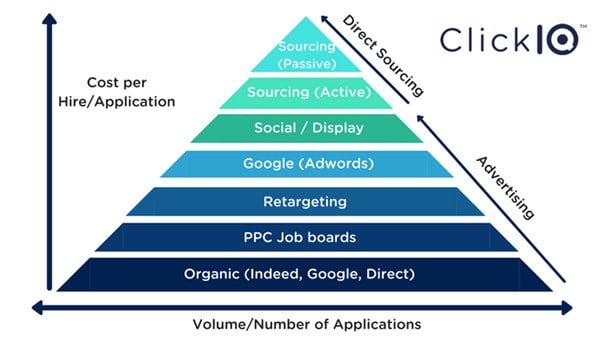
The system is able to automatically work out if a role is hard to fill and will then allocate budget in the most cost-effective way; starting with the lowest cost sources of candidates then moving up the Talent Attraction pyramid (see image). The harder the role, the further you have to move up the pyramid, but as we move up the pyramid, the number of applications decreases and the cost increases per application.
Step 1: Organic Applications
So, at the very bottom of the pyramid is organic advertising – effectively generating free applications (i.e. zero cost per hire). In this case, we are talking about sites such as Indeed and other organic job boards, such as Google (for Jobs). If ever there was a strong argument for ROI from employer branding this is it as strong brands can get over 70% of their applicants organically
Step 2: Job boards
At the next level, job boards, you will find active job seekers. They have CVs at the ready and are seeking a new role. This is the next most cost effective method to attract applications. PPC job boards are the best way to go as they massively increase your reach without having to take any financial risk (you only pay for the clicks you get).
Step 3: Retargeting
The third step is retargeting (i.e. advertising to those who have seen an advert but not applied to get them to finish their application). The average drop off rate for most roles is 90% – though this can be significantly reduced by using Chatbot technology, such as RecruitmentBot. So, this step is especially important.
Step 4: Google Adwords
Next up the pyramid is Google Adwords which is often used to target people at the beginning of their job search. It tends to be a rich but competitive and expensive source.
Step 5: Social and Display
Finally, we reach Social and Display targeting – an extremely effective way of finding passive applicants. Whilst the conversion rate is often low, the ability to do precise targeting is high. Again, it is bought on a PPC basis.
Step 6: Direct Sourcing
The very last stage of the Talent Attraction pyramid is Sourcing. Split into two categories this is used to reach Active candidates and Passive candidates.
The best way to source Active candidates is usually CVs held within talent pools and commercially available databases such as LinkedIn. This can be a highly effective method, but requires more time spent sifting, candidate communication and management which is why it comes towards the top of the pyramid.
A number of automated tools, such as Maya, Opening.io and Pocket Recruiter, are starting to appear and grow in popularity on the market. These search for relevant candidates in CV databases that meet the requirements of the roles which, when combined with a recruitment ChatBot, mean that you can find a qualified shortlist of candidates very quickly, without any human involvement.
The real dark art of the recruitment world is sourcing passive candidates, and it’s here that ‘growth hacker’ recruiters tend to live. These high-level ninjas use a variety of chrome extensions to source applicants before approaching them directly about their roles. This is highly time consuming and only required for extremely hard to fill, niche roles. It is here that the value-added recruitment agencies should live.
Stage 2: Filtering
Filtering is a critical stage of the talent attraction process, once you have collected a suitable pool of applicants to filter from.
Technology in the form of a ChatBot, such as RecruitmentBot, are being introduced into this part of the process to help Talent teams process people through the application stages by applying screening questions and requirements. If those applicants meet the requirements set, they can automatically be directed to:
– Scoring algorithms
– Online testing
– And (more recently) video interviewing.
The most advanced Bots are using video interviews with AI scoring. The machines are able to assess which applicants are most likely to be hired based on the video, as the machine conducts this process – the machine continues to learn, growing in power and usefulness.
This highly valauble data can be used to inform Talent teams which media channels work best and these can be further optimised and scaled up as a result. Launchpad currently use this scoring method on their clients.
Filtering can be automatically achieved by providing a shortlist of applicants for interview, these can be automatically scheduled in with the hiring managers.
The next stage of the Talent Attraction process shifts away from technology and automation towards manual human interaction!
Robots and The Future
The future is now. All of these methods explained above are being executed right now. Perhaps, not in the completely integratable way that is possible but in 6 months, it could arguably be.
The cost benefits to adopting automation and technology in the Talent Attraction process are so significant that whilst this technology is only being adopted by the innovating trail-blazing recruiters – the mainstream can’t afford to be far behind!
So, what do we expect the Talent Attraction process to look like in 6 months? Employers will upload their jobs, then a day/ week later will be interviewing the candidates that have been sourced, responded to advertising and shortlisted all through automation – without the Talent team having to anything but upload their job.
Interesting times!
About ClickIQ: ClickIQ is an AI powered automated Talent Attraction platform that manages and optimises recruitment advertising with a built in ChatBot.