
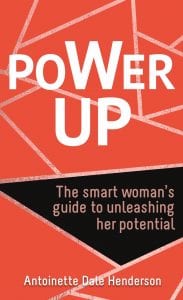
 When TEDx speaker and leadership expert Antoinette Dale Henderson got in touch to ask if I’d like an article from her on how to “power up in 2020” I couldn’t resist! Antoinette has been helping clients ‘Power Up’ in business for 25 years. Her new book Power Up is a guide to unlocking full potential and achieving success.
Assertiveness is an essential quality for success, in business at in life and can be difference between living the life you want and a life of compromise.
The dictionary definition of assertiveness is ‘a form of behaviour characterised by a confident declaration or affirmation of a statement, without the need for apologising, over-explaining or justifying’. This is useful, but I believe it’s so much more than that! So what does assertiveness look, sound and feel like?
If you look at an assertive person, you’ll see they are standing strong, unbowed, their posture straight, their gestures precise and definitive. If you listen to them speaking, their voice is clear and unwavering, the volume not too loud or too soft, the words accurately conveying their needs, thoughts and wants.
Being assertive means respecting and valuing yourself, while respecting others’ needs and feelings. It means setting limits in terms of time, energy, privacy and money. It’s about setting boundaries for yourself and others. It doesn’t mean disregarding other people’s limits, freezing with anxiety in the face of someone else’s assertiveness or expecting people to know magically what you want or how you feel. It’s calling out inappropriate behaviour, talking about the elephant in the room and surfacing conversations that people would rather keep under wraps.
To give you an example of assertiveness: the other day, I was in the quiet carriage of a train. It was 5am and, to my dismay, a really noisy family sat down in the seats next to me. Rather than trying to ignore them I said, “Do you realise you’re in the quiet carriage and everyone in here is either trying to sleep or work? Can you go and sit somewhere else?” They didn’t move but they quietened down. In the past I would have just sat there and seethed, scared of retaliation. With assertiveness, I was able to express a boundary that, for me, had been crossed and politely ask for what I wanted.
Where does assertiveness come from?
Assertiveness comes from the ability to be strong and communicate your needs and wants clearly. From a woman’s perspective, it often involves overriding some of society’s negative perceptions of an assertive woman, which can be easier said than done. Part of the secret comes from developing the ‘don’t give a damn’ gene, where you’re more concerned about doing the right thing or getting what you want than making everyone else feel OK. This is the difference between respect and likeability. It’s not that assertive people are deliberately making it difficult or awkward for others; it’s that for them, there’s a bigger agenda at play.
How can you develop it?
To tap into your assertiveness, you need to understand who you are and what you want. Assertiveness will then become a life position for you, a superpower that’s forever at your fingertips, as opposed to a technique you need to ‘try out’ in situations when you feel like you ‘need’ to be more assertive.
To be assertive, you need a clear mind. If your views are fuzzy, You will come across as wishy-washy and it will be easier for people to take advantage of you. And if you don’t take yourself seriously, how can you expect other people to?
With clarity, you will feel more confident about expressing yourself and happy to reveal your authentic self to others. You will have a more positive view of your own place in society, be open to other people’s perspectives and welcome them in, even if you disagree.
Being assertive with others
Unfortunately, the challenge comes when you have to interact with other people, none of whom will share the same purpose, identity, values and beliefs as you do and all of whom will be equally as wedded to their own ideals as you are to yours!
Although no one and nothing can make you feel anything, the more you know about which people and situations trigger feelings of being threatened in you, the more you’ll be able to remain in the assertive position and the more powerful you’ll feel.
Get in tune with your assertiveness barometer
Key to being assertive is understanding how you typically respond to different people, what stops you from being assertive and how you can stay on track. Get in tune with your assertiveness barometer by following these steps:
- Start by noting down situations where you find it easy to be assertive and people you find it easy to be assertive with. For example, your weekly team update, deciding where to go on an evening out with friends, and leading a planning meeting with colleagues at the same level or below you.
- Now write down the situations when you find it difficult to be assertive and who you find it difficult to be assertive with. For example, being invited to share your unformed opinion to a large group of people, knowing you’re the least experienced person in the room, being yourself around people in authority, those who dominate discussions, those you don’t trust or individuals who remind you of people you’ve had challenges with in the past.
- Consider when you’re more likely to flip from assertiveness to passivity, aggression, or passive aggression, and why that may be. Look for any similarities, themes, and patterns of behaviour which you find challenging, identify personality traits in other people that trigger you and consider why this might be the case.
Use your body language, voice and word choice to make the right impact
The way you position your body is directly linked to radiating an alluring and confident presence. Research conducted by social psychologist, author and speaker Amy Cuddy, a social psychologist and researcher at Harvard University, found that adopting strong and powerful postures – think Wonder Woman or Superman at their strongest – for just two minutes, has a fundamental effect on your confidence levels, at least for the time it takes to deliver a presentation or be interviewed for a new role.
The ability to attract attention to yourself and make a powerful impact is essential in a world that remembers the shiny and forgets the dull. Understand the unique qualities that represent your authentic personal brand and know how to ‘switch on’ your most magnetic self through using your attitude, body language, voice and word choice. This is what will draw people to you when working, in meetings, from the stage and online, so that you can influence them and inspire them to say ‘yes’.
Antoinette Dale Henderson is a women’s leadership expert and the author of Power Up: The smart woman’s guide to unleashing her potential. To find out more go to: https://gravitasprogramme.com/power-up/