

 A guest blog from Mike Ames, Scalability Consultant for recruitment company owners who want upscale their business. Host of the livestreamed weekly Mike Ames Recruitment Show.
In the UK, the 360-recruitment model where one person finds, qualifies, and places candidates on vacancies they have secured themselves, has been around for years.
The alternative called the Layered or the American model is relatively new to this side of the Atlantic, though not in the US, as the name suggests. But why do we need a new model and what is this new approach anyway?
I’m going to answer these questions in this article, plus I’ll explain the remuneration options and how you convert from 360 to layered. I’ve also included a case study at the end.
The Challenge of Retaining 360s
Let’s be honest; exceptional 360s are tough to find, harder to develop, and even more challenging to retain. The reality is, they’re also often future competitors in the making.
Picture this: you once were a stellar 360 who made a grand exit, taking a substantial revenue chunk with you. Why should it be different for those you employ?
There’s a term for firms caught in this vicious cycle of hiring and losing 360s – they’re called Yo-Yo companies. Rapid growth to team of 12 or more, a few key people move on, and it collapses under its own weight back down to a small core team of 6 or 7.
Some repeat that cycle more than once but sustainable development perpetually slips through their fingers. Owners usually find the frustration of this cycle overwhelming, but all to often the fundamental problem isn’t addressed – The 360 model.
What if you could steer your business towards stability and consistent growth without the need for 360s?
Introducing the Layered Model
Enter the Layered model, a recruitment strategy promising to reduce or remove many of the problems associated with 360 approach. The Layered, or American model, assigns specific functions to different roles.
Think about all the tasks a 360 must juggle, I’ve listed them out below for you and you can see it’s a lot.
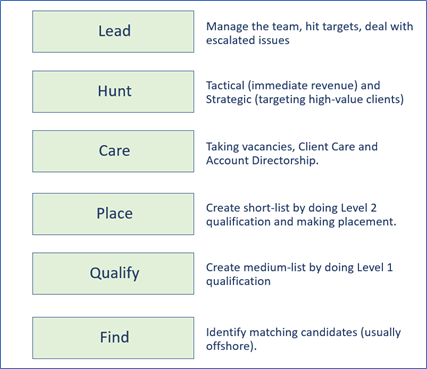
A top performing 360 needs to be proficient in five of them; six if they have a couple of resourcers working for them that they need to manage.
Now imagine a world where people focus solely on what they do best – that’s the Layered model. It’s a simple and time-tested division of labour approach that’s worked since the days of Henry Ford
As Ford and thousands since him found, adopting the layered model:
- Makes it easier to train people to the point of expertise giving exceptional results from average people.
- Enables staff to excel in their role leading to improved productivity and job satisfaction, and so increasing staff retention rates.
- Let’s you offer a variety of career paths so your people are able to commit to you long term.
The result for you is a lower stress, streamlined business with a long term and stable team delivering exceptional results!
But What About Commission?
The first question about a Layered model is invariably about the money – “How will my team react?”.
Well, the idea isn’t as revolutionary as it first seems.
Recruiters have been doing split deals for years, usually on a 50:50 or 40:60 basis between the person who won the deal and the one who managed the sourcing and placing of the candidate.
Under the layered model of recruitment, it’s not too much of a stretch to include a small cut for the original client winner. Particularly when they secure a substantial client likely to provide multiple roles.
(Something much more likely to happen if they can focus on winning those sorts of clients, without then getting distracted with delivery.)
There are several ways to factor in resourcers, but my favourite is the contribution method.
In this model the resourcers costs are deducted from the consultants Gross Profit or Net Fee Income before commission is calculated. The resourcer is considered an extension of the consultant they work for which enables the consultant to generate much more revenue than they could alone.
Imagine a consultant who hires a couple of resourcers. The boost they provide to that consultant’s productivity more than pays for their cost.
In an ideal setup, a proficient resourcer generates 2 qualified candidates a day, and the recruiter successfully places one in every 13.
So, a good resourcer can increase your placement rate by two or even three a month. All the recruiter needs to do is to find the vacancies to work on or split the fee with a Business Development Hunter
How to Transition from 360 to Layered
Your first step is to assess the strengths of your team. Who excels at hunting? Who’s best at placing or resourcing? Then, delegate roles accordingly.
Resourcers – assigned to consultants who will assume their costs and benefit from the increased revenue they generate.
Consultants – Handle construction of the final shortlist and the placement process itself. They either win vacancies via tactical BD activity or secure them from larger clients first won for them by the BD Hunter.
Strategic BD Hunter – a long term focus on winning a stream of high-value clients. One Strategic BD Hunter can keep a team of consultant fed and most owners can fill this role.
Tactical BD Hunter – shorter term focus to identify and obtain vacancies. One tactical BD Hunter should be able to keep up to six consultants fed with vacancies. However, this ratio is highly dependent on the type of role and average fee.
This new model is a leap of faith and many of your people may show scepticism. The only way you can overcome their scepticism is to offer guarantees until they make the new system work. Typically, this is 6 months but can be much less.
Looking Ahead
If your goal is a flourishing recruitment firm, free from the yoyo inducing unpredictability of the 360 model then a Layered model is, by far, the most secure way to achieve it.
Sure, it requires some adjustments and may need you to overcome some initial resistance, but the rewards are immense.
Picture your own Layered model business.
Your team are each an expert in their role. Fulfilled and productive they rarely leave and when they do, you only lose an easily replaced function, not a revenue stream.
As an established team they work incredibly efficiently together to produce outstanding results that exceed those of bigger competitors still wed to the 360 model.
Imagine the peace of mind that comes from running a business like that.
Can it really be done?
We have a video case study of a recruitment company owner, Matt Ellis, who made the transition from all 360s to a blend of layered and 360s. By doing so Matt:
- Trebled his net profit.
- Reduced his headcount by 20%
- Slashed his staff turnover to 3%
- Lifted his biggest billers from £300k to £600k.
It’s an eye-opening story on what is possible with the Layered model that you can watch here: https://www.youtube.com/live/LdG9t4qOMqM?feature=share
First Steps
If you are serious about changing the shape of your business, to start delivering the revenue, freedom and personal wealth you desire, then you should learn about the 7 Pillars of a scalable recruitment company.
Visit www.recruitmentpioneers.com and download the guide from our homepage. It’s a free and easy 15-minute read (though might trigger some long periods of reflection and thought).
 Mike has grown and sold two multi-million-pound recruitment companies from scratch. He started his first business, a recruitment company called Software Knowledge, in April 1989. With his business partner, the business grew to a group turnover of £40 million adding a software house and facilities management company along the way. He sold Software Knowledge in 1998. Mike then joined two former Software Knowledge colleagues in the formation of Crimson, where he currently is a director and major shareholder. Whilst still supporting this successful venture he now spends the majority of his time running the Flair Business Growth Consultancy.