

Making your first hire is one of the biggest steps a business can take.
One hurdle in hiring your first member of staff is making sure that you are ready to fulfil the additional tax obligations that you take on when becoming an employer.
In this guest blog GoForma go through:
- The tax obligations that you take on as a new employer.
- How you can meet these obligations.
What Are Employers’ Tax Obligations
Here are the tax obligations that you have to think about as an employer:
- Employer’s National Insurance Tax: An employer has to pay 13.8% of a full time employee’s salary. Employer’s do not have to pay this if their employees earn less than £758 a month pre-tax.
- Employee’s Pension Scheme: All UK employers must offer their staff a pension scheme. An employer must pay a minimum of 3% of their employee’s annual earnings into their pension. This is cut off at £50,270 a year, so you’d have to pay the same pension contribution to an employee earning £51,000 a year as you would for an employee earning £100,000 a year.
- Income Tax: At the time of writing (September 2024) the first £12,570 of an employee’s salary is not subject to income tax, £12571- £50,270 is subject to 20% income tax and any annual earnings over £50,270 is subject to 40% income tax. Bear in mind that this comes out of your employee’s payslip, but you have to make sure that this happens.
- Employee’s National Insurance Tax: Employees must pay 8% National Insurance tax on earnings up to £50,286 a year and then 2% on anything they earn above this. Again it is your responsibility to make sure that this comes out of your employee’s payslip.
How Do I Get Tax Ready as An Employer?
There are three steps to getting tax ready to make your first hire. They are:
- Registering with the HMRC as an employer
- Creating a hiring budget with your tax obligations in mind
- Setting up payroll
I’ll now go through these steps in more detail.
Registering as An Employer With the HMRC
Registering as an employer with the HMRC is easy – in fact if you are already a limited company then you have likely already done this as you are technically already employing yourself as a Director.
However, if you are not sure whether you’re registered then here’s what you should do:
- Get your Government Gateway Account (you can do that here).
- Sign in to set up an employer’s account here using your Government Gateway and password.
- Say which taxes you will need to pay (you’ll see an image of the check box options below.)
- Give your business’s address and you’ll be sent an activation code in the post.
- Log back into your employer’s account and use your activation code to register as an employer.
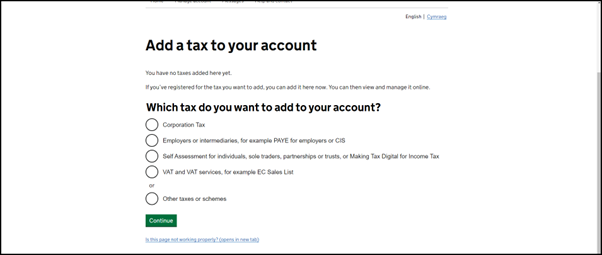
You’ll want to select the second option here.
The whole process takes no more than twenty minutes, minus waiting for the activation code in the post.
Sorting Out Your Hiring Budget
Fortunately for employers, the percentage of an employee’s salary that you have to pay in tax is the same regardless of how much they get paid.
This figure sits at 16.8%.
13.8% of this is made up of Employers National Insurance Tax and 3% of this is made up of Employers Pension Contribution. You can pay more than this if you choose to give your staff a more generous pension contribution, but that’s up to you.
To put this in perspective:
- For a full time employee on £23,500 (about minimum wage) you’d need to pay £27,488 a year.
- For an employee on £40,000 you’d need to pay £46,7200 a year.
- For an employee £60,000 you’d need to pay £70,800 a year.
Remember that variable taxes like income tax come out of an employee’s paycheck, so budgeting for employers’ tax is relatively straightforward.
Setting Up a Payroll System
Payroll refers to the process of ensuring that your employees are paid and that their taxes are deducted from their payslips.
The most cost effective way to do this as a small business is to use the UK Government’s free payroll software.
This can be used for up to 10 employees (remember that you count as one of these ten) and allows you to automate payments and tax deductions. The software will also calibrate itself automatically if any tax rules are changed.
If you have a larger team than ten then you’ll either need a private payroll software (here’s a list of the softwares that are HMRC compliant) or to outsource payroll entirely.
Summing Up
Getting tax ready as an employer is easier than you think, with the most important thing to remember that you have to pay 16.8% on top of whatever you pay your staff in tax.
Combine this with a basic payroll system and you are ready to start hiring.
GoForma wrote this article to assist solopreneurs looking to hire their first local member of staff.