
 Writing a job advert with AI is one thing. Building it into the way an agency works every day takes rather more thought. And if consultants are copying information between several different tools, the promised time savings can quickly disappear.
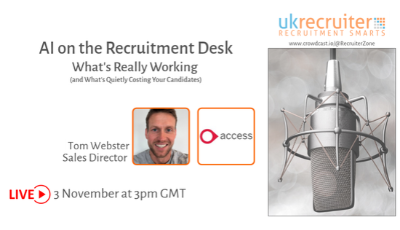
In our latest Recruitment Smarts Live conversation, Louise Triance spoke with Tom Webster of Access Recruitment about what is actually working on the recruitment desk. The discussion covered where AI can remove admin, how to protect the human relationships that make recruitment valuable, and what agency owners should expect suppliers to demonstrate.
Moving beyond occasional use
Tom described a market where AI use is widespread, but often limited to individual tasks. Consultants might draft adverts, format CVs or create marketing content without those activities being connected to the wider recruitment process.
“It’s relatively shallow usage.”
That is an understandable starting point. Tom recalled spending around 25 minutes turning a client’s job description into an advert, even once he had become good at it. Reducing that sort of repetitive work offers an immediate benefit.
The next step, he explained, is using AI to bring relevant information and suggested actions to the recruiter. Rather than spending as much time gathering information and planning what to do next, consultants can act on useful signals. That depends on understanding how the desk operates and fitting the technology into it.
Watch for admin moving between tools
Adding another AI product does not automatically make a consultant more efficient. We discussed how easily agencies can end up with overlapping tools, particularly when the pressure to keep up with competitors drives buying decisions.
If someone uses one tool to produce an output, transfers it into another, then manually updates the CRM, the agency may simply have created a new form of data entry. Each product can promise a saving while the overall process becomes slower.
Before adding something new, look at the whole workflow. What does the consultant actually have to do from beginning to end? Where is information being entered twice? It is also worth asking existing suppliers what is already available or planned before buying another tool to solve the same problem.
Keep the conversations that matter
For Tom, the value of a recruiter remains rooted in understanding people. AI can help prepare for a conversation, identify useful information and make communication easier to manage. The conversation itself still matters.
“There’s nothing wrong with getting those signals and getting that understanding and maybe some insight from AI to enable you to have better conversations, but never replace the actual conversations themselves.”
That also has implications for training. New consultants still need to learn how to ask questions, understand a brief and develop their own judgement. Working alongside experienced recruiters remains valuable, even as technology speeds up parts of the job.
Candidate experience needs the same attention. Tom argued that agencies should explain where AI and automation are being used. A prompt acknowledgement and a well-prepared recruiter can improve the experience; an automated process that leaves candidates feeling unheard can damage it.
Ask what happens to your data
The discussion also explored the risks of consultants using AI tools independently, without understanding where candidate information goes or who can access it.
Tom’s questions for suppliers were practical: where is the data going, who can see it, and do existing permissions still apply? Can the agency set clear boundaries around what the system does, and expect it to stay within them?
He described Access Evo’s approach as a secure, permissions-aligned environment designed to let agencies adopt AI at their own pace. His wider point was that ease of use needs to come with clear controls. Agency owners need to understand those controls before making a tool part of daily work.
Measure the process before promising a saving
A claim that software saves four hours a week is difficult to assess without knowing how the agency works today. Tom recommended establishing a baseline before rolling anything out.
He described Access’s AI adoption team mapping customers’ workflows across permanent, temporary and contract recruitment. That means understanding the tasks involved, how long they take and which systems consultants already use, then identifying where automation could help.
The rollout can then be measured against that starting point, with time for people to learn and adopt the changes. The useful question is whether the whole process has improved, including any extra steps introduced along the way.
Make the demonstration relevant to your agency
Tom’s advice to buyers was to ask suppliers to demonstrate a real use case with the agency’s own data and workflows, within the agreed data controls.
“Get it working on your workflows in your world.”
That is particularly helpful when experienced consultants are reluctant to change. Showing how a tool improves something they already do well gives them a concrete reason to try it. It also helps an agency preserve the processes that make it successful while removing unnecessary work.
The practical starting point is to understand a desk’s workflow, choose a specific problem and establish what improvement would look like. From there, agencies can test whether the technology delivers and whether consultants actually use it.
Find out more
Watch AI on the Recruitment Desk — What’s Really Working with Tom Webster