


Jack Roberts surveyed 57 UK recruitment and compliance leaders in August. The gap he found runs along firm size, and the firms that closed it did so years ago for reasons that had nothing to do with the Home Office.
On 1 October the right to work regime changes shape. Until now the duty to check that someone is entitled to work in the UK has sat with employers and applied to employees. From that date it extends to people engaged on contracts for services, to individual sub-contractors and to workers found through online matching platforms, with liability extending up the supply chain rather than stopping with whoever signs the timesheet. The Home Office estimates 3.75 million workers come newly into scope. The civil penalty for a first breach is up to £45,000 per worker.
For a recruitment business supplying temporary or contract labour this is a substantial change, and it lands on the part of the market that will do most of the operational work. It is also a part of the market the draft Code of Practice and the draft Employer’s Guide do not mention. Neither document uses the words employment business, agency worker, umbrella or labour supply anywhere. That absence is most of the reason I ran a survey in August to find out how ready the sector actually is. As far as I can establish, nobody had measured it, in recruitment or anywhere else.
What 57 firms said
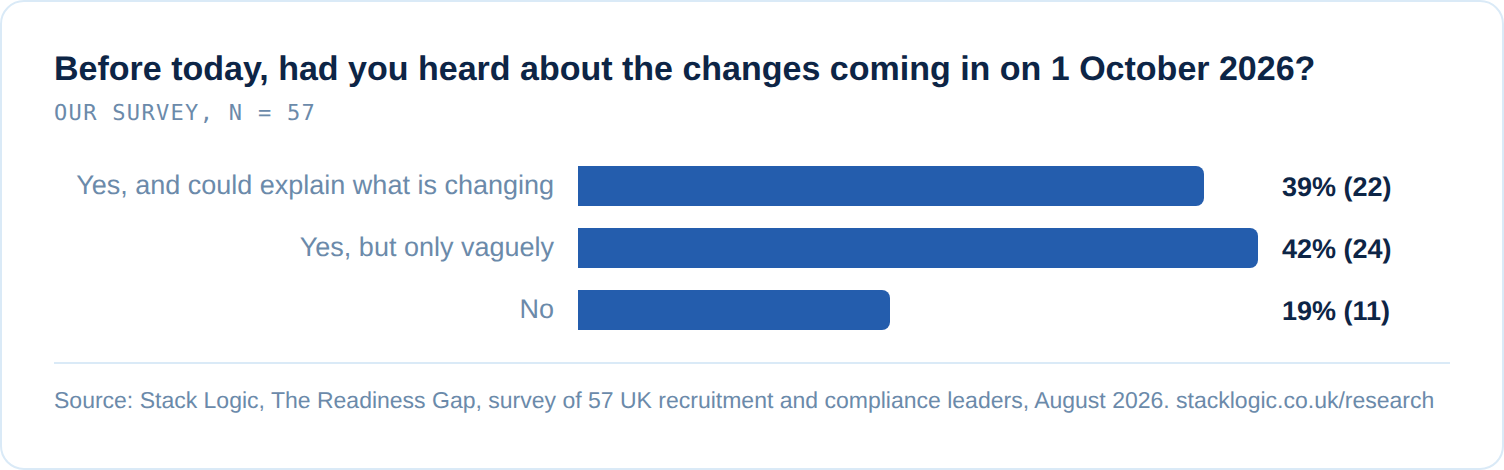
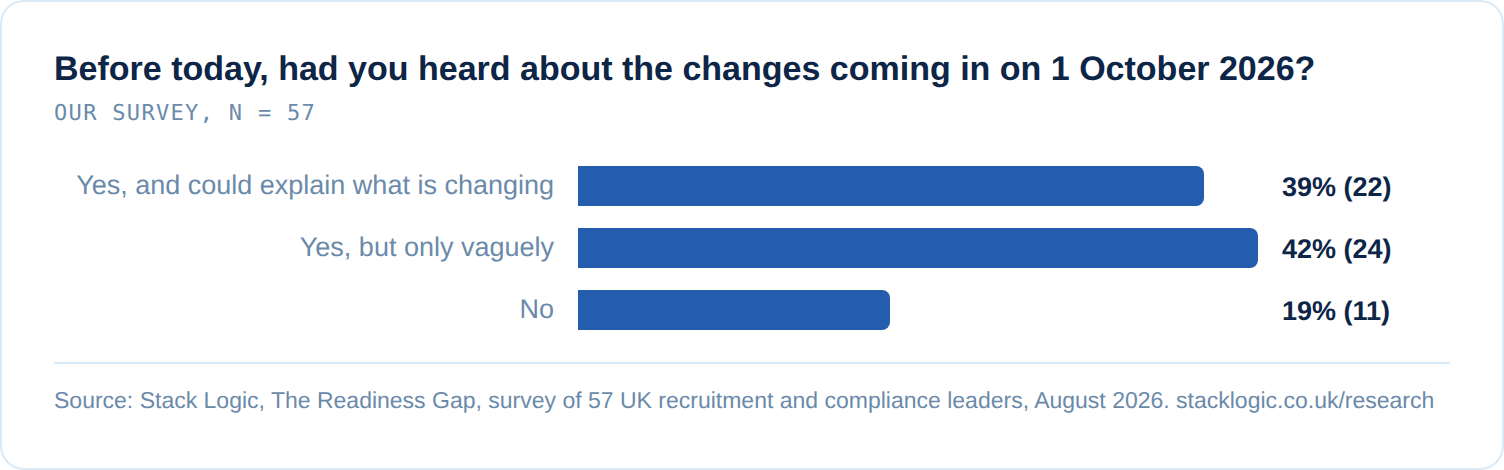
The headline finding is about awareness, though I am not sure it is the most useful one. Of 57 recruitment and compliance leaders, 22 could explain what changes on 1 October, 24 had heard about it only vaguely, and 11 had not heard of it at all. Every one of those 11 was at a firm of 25 people or fewer. At the other end, nine of the ten firms with more than 100 staff could explain the changes without difficulty. The gap is almost entirely a matter of size.
The finding I would pay more attention to is about evidence. I asked how long it would take to produce a compliant check for every worker currently on assignment, which is the question an auditor, a client’s procurement team or a Home Office compliance officer will eventually put to you. Twelve of the 57 said the same day. Sixteen said within 48 hours. Fourteen said within a week, and nine said it would take longer than that.
That spread tracks the method used to record right to work status very closely. Thirteen firms use a dedicated checking tool, and eleven of those thirteen could evidence every worker the same day. Thirteen firms track on a spreadsheet, and none of them could. One spreadsheet firm could manage 48 hours; six would need more than a week. In total 33 of the 57 track right to work manually in some form, and the Home Office’s own research suggests they will not know how exposed they are. In its 2023-24 employer survey, 89% of respondents were confident they carried out checks correctly, and 80% of them then answered a compliance question wrongly. In our data, 18 of the 19 firms who said they were not confident, or had not looked at the changes, were tracking manually. Confidence and tooling turned out to be the same measurement.

Two other things stood out. Twenty of the 57 have a named person who owns compliance, and 18 of those 20 could evidence checks within 48 hours. Where compliance sits with an office manager alongside everything else, the figure was three of fifteen. Where it sits with consultants themselves, none of seven. And 27 of the 57 have already been asked by a client for contractual guarantees about their right to work process, including 18 of the 22 temp and contract specialists and every one of the ten firms over 100 staff. No perm-focused firm had been asked. Clients are moving ahead of the guidance, and they are moving on the firms with the most to lose.
What to do between now and 1 October
Run the audit test on yourself. Pick ten workers currently on assignment at random and time how long it takes to put a compliant check in front of you for each one, including the date it was done, who did it and what document or share code it rested on. If the answer is measured in days, you have found the problem before anyone else has to.
Give the job to one person. The named-owner finding is the strongest in the data and it costs nothing to act on. A compliance hire is not required, only a person whose name is attached to it and who has the standing to chase consultants for what is missing.
Put right to work status and expiry into the system you already use before you buy anything new. Most ATS platforms will hold a date field and run a report against it. The firms in our data who could evidence same day mostly had the information in one place with an expiry recorded against it, and the particular tool mattered less than the discipline of keeping it there. Automating a spreadsheet gives you a faster spreadsheet.
Read your client contracts. If 27 of 57 firms have already been asked for warranties, the terms you signed last year may already contain a promise about your checking process that you have never tested. Find out what you have agreed to before a client does.
Map the chain for every temp. Where an umbrella or a second-tier supplier sits between you and the worker, write down who carries out the check and who holds the evidence. The draft guidance does not say, and I am not a lawyer, so take advice on your own arrangements. Until the final version is published, your own record of who did what is the only account you will have.
None of this depends on the Code of Practice being finalised. The firms in our data who are ready mostly got ready years ago, when a regulated client or a framework audit forced their hand. Nothing the Home Office publishes this month will do that for you. The client asking for a warranty already has.
About the survey
The Readiness Gap is a survey of 57 UK recruitment and compliance leaders carried out in August 2026 by Stack Logic, reached through the author’s network, targeted advertising and direct email. It is a self-selected sample and should be read as directional rather than representative. Respondents ranged from firms of one to ten people (15 of the 57) to firms of more than 100 (10); 22 were mainly temporary or contract businesses, 20 mainly permanent and 15 an even mix. Counts are reported alongside every percentage and no segment under ten respondents is broken out on its own. The full report, response counts and cross-tabulations are published at stacklogic.co.uk/research/right-to-work-readiness and may be reproduced with attribution.
Jack Roberts is the founder of Stack Logic, which builds CRM and process automation for UK recruitment businesses.